
Author: Gary

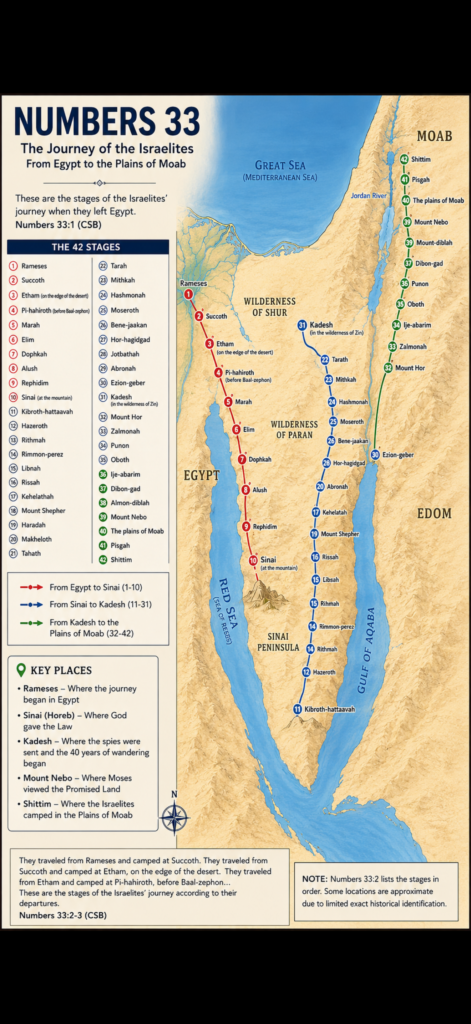
  • Numbers 33:1-56

    In Numbers 33 God wanted Israel to remember every stage. Some stops were wonderful. Some were difficult. Some stops were associated with rebellion and failure, but God was present through all of them. This should encourage us. When we look backward at our own life. We may see stages we wish we could erase, but God uses even those places in our story. The Israelites didn’t get to skip the wilderness, but God didn’t abandon them there. Jesus makes the same promise to us. In Matthew 28:18-20 Jesus says, “All authority has been given to me in heaven and on earth. Go, therefore, and make disciples of all nations, baptizing them in the name of the Father and of the Son and of the Holy Spirit, teaching them to observe everything I have commanded you. And remember, I am with you always, to the end of the age.” We must always remember that he is with us always. Even when we can’t see him or feel him he is there. Don’t forget where God has brought you. This chapter shows us that God doesn’t just care about the destination. He is present throughout the Journey. Israel probably didn’t understand the significance of every place while they were traveling through it, but when Moses looked back, he could see God’s hand throughout the entire journey. This is also true for us. There may be seasons in our lives where we don’t understand why God has allowed us to be in a particular “wilderness,” but this chapter reminds us to look backward as well as forward. Remember the places where God has already been faithful and how our journey pointed us toward Jesus. The One who delivers us from bondage, stays with us through the wilderness, calls us to trust Him, and brings us into an eternal inheritance. Love y’all! Have a great day!

  • Numbers 32:1-42

    Numbers 32 is about the tribes of Reuben and Gad asking Moses to settle on the east side of the Jordan River because they had large amounts of livestock and saw that the land there was good for their animals. Half of the tribe of Manasseh eventually joined them. Reuben and Gad saw that the land of Jazer and Gilead was suitable for livestock, so they asked Moses to let them settle there rather than cross the Jordan. Their request wasn’t necessarily sinful by itself, but Moses was concerned about what their decision would do to the rest of Israel. Moses reminded them that the other Israelites still had to fight for the Promised Land. Moses says, “Will your brothers go to war while you stay here?” This exposes an important issue. God’s people weren’t supposed to pursue their own comfort while their brothers were still fighting. Moses then reminds them of all the Israelites that would not enter the Promised Land because of fear. Moses brings up what happened at Kadesh-barnea when the Israelites refused to enter the Promised Land because they were afraid. The difference is that the Reubenites and the Gadites chose to fight with their brothers and the Israelites that couldn’t enter the Promised Land chose to embrace their fear. What does that mean for us? Truth is all of us have fear of following what God has led us to do sometimes. Do we embrace that fear and stay in our bubble or do we step out in faith and trust what God is leading us to do? If we turn away from God it could affect more than just ourselves. It could affect our families and everyone else around us. Ignoring God has consequences and the truth is we may not ever see what those consequences are. The definition of faith is defined by the actions we take. It is easy to say “Lord let your will be done.” It is a whole other thing entirely to take action on what God is calling us to do. For example, I can tell anyone that I believe i’ll go to the moon someday. It means another thing entirely if I actually start taking the steps to do it. If I actually believed that I would go to the moon I would start to taking action. I would start working on the schooling required, staying in shape, and applying for any astronaut program I could find. The same is true when I say I believe that Jesus died on the cross for my sins and that believing in him is the only way to heaven. If I honestly believed that then I would start taking action. That means that I would start reading my Bible. That means I would start looking to him through prayer for my decisions instead of doing what feels right. That means that I would start telling everyone around me about him because I want everyone to go to the same heaven that I’m going to because I believe it. If I actually believe in Jesus I would start to take action. True faith will never be just words we say they will be the actions we take. We must say what we mean and mean what we say so that our words matter and they make a difference. Love y’all! Have a great day!

  • Numbers 31:1-54

    Numbers 31 is a chapter that describes Israel’s battle against the Midianites and then gives instructions about how the Israelites were to handle the victory and the spoils of war. It also connects to the themes of holiness, judgment, obedience, and ultimately the need for a greater Savior. God tells Moses, “Take vengeance on the Midianites for the Israelites.” This goes back to Numbers 25. The Midianites had participated in leading Israel into sexual immorality and idolatry through the incident involving Baal of Peor. So this battle wasn’t simply Israel expanding its territory. It was God’s judgment against Midian for deliberately drawing Israel away from Him. Moses sends 12,000 Israelite men into battle. 1,000 from each tribe and Israel defeats Midian. Balaam is also killed in this battle. Balaam was a prophet that heard directly from God and still advised the Midianites to entice Israel into sin. When the soldiers return, Moses becomes angry because they allowed the women who had participated in leading Israel into sin to live. The important thing about this is that it is describing a specific act of divine judgment against a people who had intentionally participated in Israel’s spiritual corruption. It isn’t a general command for God’s people to harm other nations or people. The Old Testament repeatedly shows that God takes idolatry and deliberate rebellion against Him extremely seriously. After the battle, God gives instructions for purification. The soldiers had come into contact with death, so they had to undergo ceremonial cleansing. Before Jesus came, sin and death would make a person contaminated. God’s people had to be cleansed before returning to the community. Hebrews 9:14 says, “how much more will the blood of Christ, who through the eternal Spirit offered himself without blemish to God, cleanse our consciences from dead works so that we can serve the living God?” The physical cleansing rituals in Numbers point toward the deeper spiritual cleansing that Jesus provides us. God also gives Moses instructions for dividing everything Israel captured. The soldiers who fought received their portion, while the rest of the community received another portion. A portion was also given to the Levites. This demonstrates that the victory ultimately belonged to God. Israel wasn’t supposed to view the spoils simply as their own personal possessions gained through military strength. The Israelite officers realized that not one of their men had been killed in the battle so they voluntarily brought an offering of gold to the Lord. They weren’t just following orders. They recognized that God had protected them and they responded with gratitude. Moses and Eleazar took the gold and placed it in the tent of meeting as a memorial before the Lord. When we view this moment in history through the lens of what Jesus has done for us it reminds us of something even greater. We need more than external purification. We need hearts cleansed from sin. The Old Testament repeatedly shows us the problem. Humanity cannot make itself holy enough without a savior. Jesus is the answer to that problem. He doesn’t just cleanse the outside, He transforms us from the inside out. He works in us and through us. Love y’all! Have a great day!

  • Numbers 30:1-16

    Numbers 30 discusses situations involving husbands, fathers, and authority over vows. In ancient Israel, certain vows could be affirmed or nullified by the appropriate authority. That doesn’t mean these specific household regulations are a direct prophecy about Jesus. Rather, the broader biblical principle is that God establishes authority and holds people accountable for what they say and do. This chapter is about vows, promises, and the seriousness of our words before God. It may seem like a chapter mostly about ancient Israelite laws concerning vows, but for us it points to an important truth that is fulfilled in Jesus. God takes our commitments seriously, and ultimately Jesus is the One who perfectly fulfills what humanity cannot. In the sermon on the mount Jesus explains this.

    Matthew 5:33-37
    “Again, you have heard that it was said to our ancestors, You must not break your oath, but you must keep your oaths to the Lord. , But I tell you, don’t take an oath at all: either by heaven, because it is God’s throne; or by the earth, because it is his footstool; or by Jerusalem, because it is the city of the great King. Do not swear by your head, because you cannot make a single hair white or black. But let your ‘yes’ mean ‘yes,’ and your ‘no’ mean ‘no.’ Anything more than this is from the evil one.”
    ‭‭
    When we tell someone we are going to do something, can they trust what we say? I know when I was younger and I was known for telling lies to try to get away with something I would sometimes feel that I had to say things like “I swear to God” or “I put that on my mama” or “if I’m lying I’m dying” to make someone believe me. Truth is you couldn’t trust me as far as you could throw me. If I was trying to get my way I would lie in a heartbeat. If we have to say any of these things for someone to believe us we’re probably not a person that is very trustworthy. Jesus is explaining how important this is. It builds the very foundation of who we are as a person. If our word doesn’t mean anything to people, does it mean anything to God? When we take oaths and promises we should treat them with the utmost importance. If we mean what we say and say what we mean we can always stand on that. This goes as deep as when we give our lives to Christ. When we tell God that “we believe in what he did on the cross” or “we believe Jesus was resurrected from the dead” are they just words or do we mean it? When we say that “we give our lives to Jesus” can our word be trusted? Standing on truth is literally a matter of life and death. When we gave our lives to Christ did we actually mean what we said or were they just words? This is how serious telling the truth and being a straight shooter is. It molds the very being of who we are and what we stand for. Every time we tell that little white lie or keep that secret that we think would be better for us to keep to ourselves it acts like a cancer that ferments in us from the inside out. It literally tears us apart little by little. Be the person that people can trust and be the person that God can trust. Let your “yes” mean yes and your “no” mean no. When you say what you mean and mean what you say you can be trusted by people and you can be trusted by God. As a believer in Jesus, that is who we should strive to be. Love y’all! Have a great day!

  • Numbers 29:1-40

    Numbers 29 is about the appointed offerings Israel was commanded to bring during the seventh month, especially the Feast of Trumpets, the Day of Atonement, and the Feast of Tabernacles. It seems like a long list of animals and sacrifices, but it is so much more than that. These animals and sacrifices point forward to very important truths about Jesus. One thing that stands out is the number of animals sacrificed. During the Feast of Tabernacles, sacrifices were offered repeatedly over several days. It shows the limitations of the Old Covenant sacrificial system. No matter how many sacrifices were performed the sacrifices never ended. The people continually sinned. Sacrifices continually had to be offered. Sin never stopped and so did the sacrifices. This is why it is important to always remember Jesus defeated death, hell, and the grave. Before Jesus, sin was just held at bay by sacrifices that were not sufficient enough. Priests continually had to minister, but Jesus came as the once for all sacrifice. This chapter also describes a special assembly on the eighth day. Throughout Scripture, the number eight carries the idea of a new beginning. The Feast of Tabernacles ends with this special day after the seven day feast. This gives us a picture that ultimately finds fulfillment in Christ. God is bringing us into something greater than the temporary earthly arrangements of the Old Covenant. Jesus doesn’t just restore us. He adopts us and makes us into a new creation. The animals died because of sin. Jesus willingly died for sinners. The priests offered sacrifices repeatedly. Jesus offered Himself once. The tabernacle represented God’s presence among Israel. Jesus is God dwelling among humanity. The Old Testament sacrificial system wasn’t God’s final plan for dealing with sin. It was a picture pointing forward to Jesus Christ, the perfect Lamb of God who would make atonement once and for all and for anyone who will put their faith in Him. There is nothing we can do to be saved other than accept what Jesus has already done for us. Ephesians 2:8-9 says, “For you are saved by grace through faith, and this is not from yourselves; it is God’s gift — not from works, so that no one can boast.” Love y’all! Have a great day!

  • Numbers 28:1-31

    In Numbers 28 God gives Israel instructions for their daily, weekly, monthly, and yearly offerings. He explains the daily offering, the sabbath offering, the monthly offering, and the passover offering.

    Daily offering:
    Every day, Israel was to offer two one year old male lambs without blemish. One in the morning and one in the evening. These sacrifices were to be offered continually. The important idea is that worship and atonement were not occasional things. Israel was reminded every day that approaching a holy God required sacrifice.

    Sabbath offering:
    On the Sabbath, additional sacrifices were offered. The Sabbath was a special day set apart for God, and the additional offering reinforced Israel’s dependence on Him.

    Monthly offering:
    At the beginning of each month, Israel offered bulls, a ram, and seven lambs, along with grain and drink offerings. These sacrifices marked the beginning of each new month and reminded Israel that their time, possessions, and worship belonged to God.

    Passover offering:
    The Passover was celebrated on the 14th day of the first month, followed by the Festival of Unleavened Bread. This is particularly important when we look at Jesus. The Passover lamb was killed so that Israel would be spared from judgment in Egypt. Centuries later, Jesus was crucified during Passover.

    1 Corinthians 5:7 says, “Clean out the old leaven so that you may be a new unleavened batch, as indeed you are. For Christ our Passover lamb has been sacrificed.” Jesus became the fulfillment of what the Passover lamb represented. The sacrifices of Numbers 28 were repeated because they could never permanently remove sin. Jesus’ sacrifice was offered once and was sufficient forever. Israel’s priests had to keep standing because their work was never finished. Jesus sat down because His sacrificial work was finished. He stood up on his nail pierced feet and in his final breath he said “it is finished.” Jesus wasn’t just another sacrifice. He was the perfect sacrifice. He was the spotless Lamb who took our place. Love y’all! Have a great day!

  • Numbers 27:1-23

    Numbers 27 shows God’s justice, faithfulness, and plan for His people. The daughters of Zelophehad receive their father’s inheritance, showing that God cares about what is right and just. God then tells Moses that he will not enter the Promised Land and appoints Joshua as the next leader of Israel. God tells Moses to go up Mount Abarim and look at the land He has given Israel, but Moses will not enter it because of his disobedience at Meribah. Meribah is where Moses pridefully disobeyed God by striking the rock instead of following God’s specific command to speak to it. Moses also represented the Law, but the Law could not ultimately bring God’s people into their eternal inheritance. Jesus is the one who ultimately leads his people into salvation and eternal life. Joshua would lead the Israelites into the Promised Land, but his leadership ultimately points to Jesus, the greater Joshua. Jesus is the ultimate Savior and Shepherd who leads His people into an eternal inheritance and gives them the true rest and salvation that the Promised Land pointed toward. Joshua could bring Israel into the earthly Promised Land, but even that wasn’t the final fulfillment. Joshua brought Israel into an earthly inheritance. Jesus brings us into an eternal inheritance. Joshua’s leadership was temporary. Jesus is our permanent eternal king. Joshua conquered enemies in the Promised Land. Jesus defeats sin, death, and Satan. Joshua led God’s people into Canaan. Jesus leads us into the eternal kingdom of God. The Old Testament isn’t just a bunch of stories. The Old Testament is the history of how God’s perfect plan comes to pass as he uses imperfect people in an imperfect sinful world. Nobody born in this world is perfect or will ever be perfect until they accept what Jesus did for them on the cross. Only through the blood of Jesus are we perfected and made righteous to God in heaven. Love y’all! Have a great day!

  • Numbers 26:1-65

    Numbers 26 takes place near the end of Israel’s 40 years in the wilderness. The first generation that came out of Egypt has largely died because of their rebellion and unbelief. God tells Moses and Eleazar to take another census of Israel. The first census was in Numbers 1. Now, almost 40 years later, God counts the people again. The important thing is that this is a new generation preparing to enter the Promised Land. The old generation has passed away. God had previously judged the generation that refused to trust Him when the spies returned from Canaan. This shows that God takes sin and unbelief seriously. Israel had been rescued from Egypt, but being physically rescued from Egypt did not mean they could live however they wanted. Their unbelief prevented that generation from entering God’s promised rest. One thing to recognize is that God preserves a remnant. He doesn’t completely wipe them out. Even though judgment came upon the rebellious generation, God did not abandon Israel. He continued His covenant promises. The children of the generation that died in the wilderness were still there. This shows that people can fail but God’s promises won’t. Jesus is the ultimate fulfillment of God’s covenant promises. God promised Abraham that through his offspring all nations would be blessed. Jesus is that promised offspring. Human failure does not cancel God’s faithfulness. Israel failed repeatedly, but God continued moving His plan toward Christ. It is also important to remember that the God revealed in Numbers is the same God revealed perfectly in Jesus. Something I think is cool is the two men from the older generation who survived to enter the Promised Land were Joshua and Caleb. Joshua eventually leads Israel into the Promised Land. The name Joshua in Hebrew is closely related to the name Jesus. Both communicate the idea of “Yahweh saves.” Joshua led Israel into an earthly promised inheritance. Jesus leads His people into an eternal inheritance. Joshua could bring Israel into Canaan. Jesus brings His people into God’s eternal kingdom. God has an inheritance for us. He has had an inheritance for us since the beginning. When man sinned in the Garden it separated us from God. Jesus spared his blood on the cross to defeat the sin and death that we brought onto this world so that we might have the relationship with God that was always intended. He loved us enough to die for us. All he requires is that we see that love he freely gave to us and live for him. Love y’all! Have a great day!

  • Numbers 25:1-18

    Israel is camped at Shittim near the Promised Land. Instead of remaining faithful to God, the Israelites begin participating in sexual immorality with Moabite women and worshiping the false god Baal of Peor. God’s anger burns against Israel, and a plague breaks out among the people. Moses commands Israel’s judges to deal with the rebellion. Then an Israelite man openly brings a Midianite woman into the camp, right in front of Moses and the people. Phinehas, the grandson of Aaron, takes action and kills both of them. The plague then stops. The chapter ends with God honoring Phinehas and giving him a covenant of peace.
    There is a Gospel pattern here. Israel sinned. God’s judgment came. A representative intervened. The plague stopped. Then God established a covenant of peace. The Gospel takes that pattern and is ultimately fulfilled. Humanity sinned. God’s righteous judgment against sin remained. Jesus, the sinless representative, stepped into our place. He bore God’s judgment on the cross. The punishment was satisfied and everyone who trusts in Him receives peace with God. Jesus didn’t die because God stopped caring about sin. He died because God takes sin so seriously that justice had to be satisfied and God loved us enough to satisfy that justice through His own Son. Love y’all! Have a great day!

  • Numbers 24:1-25

    Numbers 24 records the final prophecy of Balaam. King Balak had hired Balaam to curse Israel, but God would not allow it. Instead of curses, Balaam spoke blessings and revealed some remarkable prophecies about the future. Balaam saw the nation of Israel camped in the wilderness, and the Spirit of God came upon him. He described Israel as a people specially chosen and blessed by God. When Balaam is filled with the Holy Spirit he says, “Blessed are those who bless you, and cursed are those who curse you.” This echoed God’s promise to Abraham in Genesis 12:3. Through Abraham’s descendants, God would eventually bring the Messiah into the world. Balak was furious because Balaam had not cursed Israel. He had promised Balaam wealth and honor, but Balaam remained firm and insisted that he could speak only the words God gave him. Balaam saw God rightfully for who he was. He understood that no matter what he did God’s will would prevail. It would prevail with him or without him. The most important part of this chapter is the prophecy directed toward the promised Messiah. Verse 17 says, “I see him, but not now; I perceive him, but not near. A star will come from Jacob, and a scepter will arise from Israel.” The star symbolizes a ruler, and the scepter represents kingship and authority. Many Christians believe this prophecy ultimately points to Jesus. Hundreds of years later, wise men from the East followed a star to find the newborn King (Matthew 2:1–2). Jesus was born from the line of Abraham, Isaac, Jacob, and David and became the eternal King. Balaam then prophesied the defeat of several nations, including Amalek, the Kenites, and others. These prophecies demonstrated that God rules over all nations and directs the course of history. Jesus is the star from Jacob and He is the king who holds the scepter. Kings carry scepters as symbols of their authority. Jesus is the King of kings whose kingdom will never end. Balak tried to oppose God’s people, but he failed because God was protecting them. In the same way, no one can stop God’s plan of salvation through Jesus. God promised Abraham that all the nations of the earth would be blessed through his descendants. Jesus fulfilled that promise by offering salvation to both Jews and Gentiles. This chapter ultimately teaches us that God always accomplishes his purposes. Balaam intended to speak what God commanded, Balak failed in his attempt to oppose God’s will, and God’s promise of the Messiah moved one step closer. Even when we cannot see what God is doing, he is still working according to his perfect plan. The Star that Balaam saw from a distance has come, and his name is Jesus Christ. Love y’all. Have a great day!