
Author: Gary

  • Deuteronomy 7:1-26

    Deuteronomy 7 is a powerful chapter because it moves from Israel entering the Promised Land to a deeper message about God choosing His people, calling them to holiness, and loving them faithfully. All of these themes point forward to Jesus. Moses is speaking to Israel just before they enter the Promised Land. God tells them that He is going to give them victory over the nations living there. But God gives Israel a warning. He tells them don’t become like the nations around you. Don’t worship their gods or adopt their sinful ways. Stay faithful to Me. One of the most important parts is when God tells Israel that He didn’t choose them because they were the biggest or most impressive nation. He chose them because He loved them and kept His promise to their ancestors. This is important because God’s relationship with His people begins with His grace, not because they earned it. This applies to us fully today. We don’t come to God because we’re good enough. Salvation is God’s gift through Christ. Ephesians 2:8-9 says, “For you are saved by grace through faith, and this is not from yourselves; it is God’s gift — not from works, so that no one can boast.” It is easy to fall into the trap mentally that we have anything to do with our salvation. We must always remember everything that we have comes from God and God alone. We must always boast in his name for his glory. The second we start to boast for ourselves we need to take a step back.

    This chapter also shows that God called the Israelites to be holy. The word “holy” simply means to be set apart. Israel was supposed to be different from the nations around them. Jesus gives us the same calling. Matthew 5:14-16 says, “You are the light of the world. A city situated on a hill cannot be hidden. No one lights a lamp and puts it under a basket, but rather on a lampstand, and it gives light for all who are in the house. In the same way, let your light shine before others, so that they may see your good works and give glory to your Father in heaven.” As believers in Christ we aren’t supposed to simply blend into the culture around us. We’re supposed to live differently because we belong to Christ. That doesn’t mean we’re better than everyone else. It means we’ve been set apart to represent God. This doesn’t mean we have to isolate ourselves from people who don’t believe like we do. Jesus Himself spent time with sinners. The issue is who is influencing who. Jesus calls us to be in the world without becoming like the world. Romans 12:2 says, “Do not be conformed to this age, but be transformed by the renewing of your mind, so that you may discern what is the good, pleasing, and perfect will of God.” Don’t let the things around you pull you away from God. Israel was also about to face nations that were stronger and larger than them. God tells them not to be afraid. Why? Because God would go before them. They were supposed to remember what God had already done. Today, we also have our battles. Not against human beings, but against sin, temptation, fear, and spiritual evil. We must look at all of our battles and know that Jesus has already won the ultimate victory. John 16:33 says, “I have told you these things so that in me you may have peace. You will have suffering in this world. Be courageous! I have conquered the world.” Through Jesus, people from every nation can become God’s people. Jesus is the only one who can give us true peace and rest because through him and him alone we are made righteous. Love y’all! Have a great day!
  • Deuteronomy 6:1-25

    Deuteronomy 6 is one of the most important chapters in the Old Testament because it gets to the heart of what God wanted from His people and ultimately what he wants from us God wants more than just outward obedience. He wants a heart completely devoted to Him. Now I’m not good at quoting scripture but it might be a good idea to be able to quote verses from this chapter. I say this because when Jesus was tempted by Satan he quoted 2 verses from this chapter to fight against what Satan was tempting him with. Satan offers Jesus the kingdoms of the world and says, worship me and I’ll give them to you. Jesus responds with Deuteronomy 6:13.. “Then Jesus told him, “Go away, Satan! For it is written: Worship the Lord your God, and serve only him.” Jesus Himself used Deuteronomy 6 to resist Satan. Then Satan tries to tempt Jesus to test God by throwing Himself from the temple. Jesus responds to Satan by quoting Deuteronomy 6:16. “Jesus told him, “It is also written: Do not test the Lord your God.” Again, Jesus answers Satan using this chapter. When Jesus is tempted by Satan he quotes scripture to fight him off. That is why it is so important to hide God’s word in our hearts. When temptation from Satan comes at us we need to have God’s word stored inside of us to lead us away from Satan’s temptations. This chapter is telling us not to just believe God exists. We are called to give God our entire lives. Notice that Jesus didn’t say the greatest commandment was to go to church, know the Bible, give money, do good works, or follow religious traditions. He said to simply love God. Our outward obedience is supposed to come from our inward relationship with God. Another thing that Moses says is that God’s commands are to be on their hearts and that parents should teach them diligently to their children. This is important because God wasn’t just concerned about one generation. He wanted faith passed down. Our children shouldn’t only hear about God at church. They should see what loving God looks like in our lives everyday. This should be true in the good times and the hard times. God tells Israel that when they enter the Promised Land and receive houses, land, wells, vineyards, and everything they didn’t build themselves, they must not forget Him. In simple terms God is saying don’t forget where your blessings come from. This is still relevant for us today. It’s easy for us to pray when we need something. It’s harder to remain dependent on God when everything is going good. We are to be consistent in both seasons. Love y’all! Have a great day!

  • Deuteronomy 5:1-33

    Israel is standing on the edge of entering the Promised Land and Moses reminds them of the covenant God made with them at Mount Sinai. God was establishing how His people were supposed to live in relationship with Him and with one another. The problem is that Israel and humanity in general could not perfectly keep God’s law. That sets up the need for something greater which is a savior. Moses repeats the 10 commandments to the Israelites so that they might not forget what God required of them.

    The 10 Commandments:
    Have no other gods
    Do not make idols
    Do not misuse God’s name
    Keep the Sabbath holy
    Honor your father and mother
    Do not murder
    Do not commit adultery
    Do not steal
    Do not give false testimony
    Do not covet

    Jesus didn’t come to tell people that God’s law was bad. He came to fulfill it. In Matthew 5:17 Jesus says, “Don’t think that I came to abolish the Law or the Prophets. I did not come to abolish but to fulfill.” Jesus perfectly obeyed what Israel and all of us have failed to obey perfectly. To simplify things, the Ten Commandments can be divided into two commands. Love God. Love people. Jesus summarized the entire law this way. When one the Pharisees asked Jesus, “Teacher, which command in the law is the greatest?” He said to him, “Love the Lord your God with all your heart, with all your soul, and with all your mind. This is the greatest and most important command. The second is like it: Love your neighbor as yourself. All the Law and the Prophets depend on these two commands.” What Jesus is saying is that if we love God perfectly and love people perfectly we will be in accordance with the law. Problem is that this is impossible without God. No man has ever walked this earth and done this but Jesus Christ which made him the one and only perfect sacrifice for us. 2 Corinthians 5:21 says, “He made the one who did not know sin to be sin for us, so that in him we might become the righteousness of God.” Love y’all! Have a great day!

  • Deuteronomy 4:1-49

    Deuteronomy 4 is one of Moses’ strongest calls for Israel to remember God, obey Him, and never replace Him with idols. It also points forward to Jesus in several important ways. Moses is speaking to Israel before they enter the Promised Land. He reminds them to listen to God, obey His commands, not to add or take away from what God has commanded, to remember what God has done for them, not to worship anything God created, to teach God’s ways to their children, not to turn away from God or there will be consequences, to seek God with all their heart so they will find Him, and that God is merciful and will not abandon His people. The major themes of this chapter is to not forget who God is. Moses says, “You must not add anything to what I command you or take anything away from it.” This connects strongly to Jesus because Jesus came not to contradict God’s Word, but to fulfill it. In Matthew 5:17-18 Jesus says, “Don’t think that I came to abolish the Law or the Prophets. I did not come to abolish but to fulfill. For truly I tell you, until heaven and earth pass away, not the smallest letter or one stroke of a letter will pass away from the law until all things are accomplished.” The Old Testament was pointing toward Christ. Jesus is the fulfillment of what God had been revealing throughout Israel’s history. Moses also says “Only be on your guard and diligently watch yourselves, so that you don’t forget the things your eyes have seen.” God didn’t want Israel to experience Him and then forget Him. They were supposed to pass what they had learned to their children. That same principle applies to us following Jesus today. Faith isn’t supposed to be something we keep to ourselves. We’re called to make disciples and teach others to follow Christ. Moses also warns Israel not to make an image of anything in creation and worship it. Anything that takes God’s rightful place in our lives can become an idol. Money, work, possessions, success, relationships, sports, comfort, and even our own desires can become more important to us than God. In Matthew 6:24 Jesus says, “No one can serve two masters, since either he will hate one and love the other, or he will be devoted to one and despise the other. You cannot serve both God and money.” You cannot serve both God or anything else. God’s jealousy isn’t like sinful human jealousy. It means God rightfully demands exclusive worship because He alone is God. He is not jealous of us. He is jealous for us. There is a difference. This helps us understand why the gospel is so serious. Jesus doesn’t come just to make our lives a little better. He calls us to surrender our lives to Him. The question every one of us should ask ourselves is “is Jesus Christ the main focus of my life?” What drives the decisions that we make in life? If it isn’t Jesus then it is safe to say we need to take a step back and regroup. It is so easy to let something become an idol in our lives. As Christian’s, Jesus Christ and what he did on the cross should drive every decision that we make. Love y’all! Have a great day!

  • Deuteronomy 3:1-29

    Deuteronomy 3 is a powerful chapter because Moses is looking back at Israel’s victories east of the Jordan while also showing that God’s promises are being fulfilled, but Moses himself will not be the one to lead Israel into the Promised Land. The chapter starts out with Israel defeating Og and taking his territory. The important lesson to learn here is that Israel didn’t win because they were stronger. They won because God fought for them. For us Jesus has already accomplished the victory that we could never accomplish ourselves. Jesus defeats the greatest enemies that we face which is sin, death, and Satan. 1 Corinthians 15:57 says, “But thanks be to God, who gives us the victory through our Lord Jesus Christ!” After he sees all of these victories Moses divides the conquered land among the tribes of Reuben, Gad, and half of Manasseh. What we should not is that those tribes aren’t allowed to simply settle down and forget about everyone else. Their fighting men must cross over the Jordan and help their brothers take the Promised Land. This is a picture of God’s people working together rather than living only for themselves. Jesus gives us as followers a similar mission. We aren’t saved simply to sit still and enjoy God’s blessings. We’re called to help others know Christ. Moses tells Joshua not to be afraid. Why? Because Joshua is going to face enemies that are bigger and stronger than Israel. Moses tells him to remember what God has already done. This is the same for us. We should always remember God’s past faithfulness when we are facing today’s battle. For Christians, we have an even greater reason for confidence because Jesus has already won the ultimate victory. John 16:33 says, “I have told you these things so that in me you may have peace. You will have suffering in this world. Be courageous! I have conquered the world.” The most significant part of this chapter is when Moses asks God if he can enter the Promised Land. God says no. Moses will see the land from Mount Pisgah, but he will not enter it. Why? Because of Moses’ disobedience at Meribah in Numbers 20. Moses had struck the rock instead of following God’s instructions to speak to it. Moses was a great leader. He delivered Israel from Egypt, he received God’s law, and he led Israel through the wilderness. But Moses couldn’t bring God’s people into their final inheritance. This is no accident. It points forward to Jesus. Moses represents the Law. Joshua (the man who actually leads Israel across the Jordan) has a name that is essentially the Hebrew equivalent of Jesus. (Yeshua/Joshua both mean “The LORD saves.”) There is a picture that is starting to get painted here. Moses brings the people to the edge. Joshua brings them in. Ultimately the Law cannot save us. Jesus saves us. Paul explains that the Law exposes sin but cannot justify us before God. Salvation comes through faith in Jesus Christ. Romans 10:4 says, “For Christ is the end of the law for righteousness to everyone who believes.” There’s also something deeply emotional here. God allows Moses to see the land that he isn’t allowed to go into. He knows God’s promise is real, but he doesn’t get to experience it himself. This should show us that God’s promises don’t depend upon one particular human being. Moses dies, Joshua continues, Israel continues, and God’s plan continues. Ultimately, the story is pointing beyond Joshua and toward Christ. Joshua could lead Israel into an earthly inheritance, but Jesus leads us into an eternal inheritance. God fights the battles that we cannot win and the salvation He promises ultimately comes through the One greater than Moses and Joshua which is Jesus Christ. Love y’all! Have a great day!

  • Deuteronomy 2:1-37

    In Deuteronomy 2 Israel had been wandering in the wilderness for a long time because of their rebellion and unbelief. Now God was telling the new generation that it was time to move forward. God gave them some very specific instructions. They were not to attack the descendants of Esau (Edom), because God had given that land to Esau. They were not to attack Moab, because God had given that land to the descendants of Lot. They were not to attack Ammon, for the same reason. God was teaching Israel that He is sovereign over nations and their boundaries. Eventually, God told Israel to fight Sihon, king of Heshbon, because God had given that land into Israel’s hands. Israel wasn’t supposed to take whatever they wanted simply because they were God’s people. They had to obey God’s instructions and trust His timing. The old generation had died in the wilderness and now a new generation was preparing to enter the Promised Land. Israel’s victory wasn’t ultimately because they were stronger than everyone else. It was because God was going before them. There are several connections between God and Israel that correlate with our relationship with Jesus. Jesus leads us out of wandering. Before Christ, humanity is separated from God by sin. Jesus calls us to turn around, follow Him, and enter into a new life with God. Jesus is the greater leader who doesn’t just lead us toward a piece of land. He leads us into right standing with God. Through Jesus we receive an inheritance far greater than physical territory. Israel was looking for an earthly inheritance. Jesus gives us an eternal one.

    Also, Israel couldn’t earn God’s promise by their own strength. Israel’s victories came because God gave them victory. For us this means our salvation isn’t something we accomplish through our own strength or good works. Ephesians 2:8-9 says, “For you are saved by grace through faith, and this is not from yourselves; it is God’s gift — not from works, so that no one can boast.” Israel needed to trust God to give them the land. We need to trust Christ to save us. Throughout the Old Testament, God’s people repeatedly face enemies they cannot ultimately overcome on their own. Jesus eventually defeats sin, death, and Satan which are the greatest enemies of all. The ultimate victory doesn’t come through Israel’s military strength. It comes through Jesus’ death and resurrection. When we fail, God’s will never fails. Jesus is the ultimate fulfillment of God’s promises. When Jesus said “it is finished” that’s exactly what he meant. All anxiety should cease and we should be able to rest in the fact that sin cannot tear us away from God any longer because it has been defeated. When we are saved through faith in Jesus, sin no longer has a grasp on us. We are covered by the perfect blood of Jesus and that is something sin cannot penetrate. Love y’all! Have a great day!

  • Deuteronomy 1:1-46

    Deuteronomy 1 is essentially Moses giving Israel a history lesson before they enter the Promised Land. He reminds the new generation what happened when their parents stood at the edge of Canaan, refused to trust God, and were forced to wander in the wilderness. Moses reminds the Israelites of what happened when God told them to go into the Promised Land. God had already rescued them from Egypt, provided for them, and promised to give them the land. But when they saw how strong and powerful the people living there were, they became afraid and refused to trust God. Joshua and Caleb were different. They believed God would keep His promise and that He would help them defeat their enemies. Because the rest of Israel refused to trust God, that generation had to wander in the wilderness for 40 years instead of entering the Promised Land. The main lesson is that fear can cause us to forget how faithful God has already been. Israel had seen God do incredible things, but they allowed what they saw in front of them to become bigger than their faith in God. When we look at our circumstances and troubles is our faith strong enough to know that God can handle all of them? Do we remember what God has promised us through Jesus Christ? We lose sight that our God literally holds this whole universe in his hands. Scientists can’t even measure how far this universe goes and yet we think he can’t handle our own situations in our personal lives. God has given us a promise through our Lord Jesus Christ than should push us to have an eternal mindset. Through faith in Jesus we will one day dwell with God forever. We become fixated on this life we are living in now and live our lives as if this life is it. Some lives on this earth last longer than others on this earth but through Jesus Christ we will live in eternity with him. As believers in Christ this is why we have peace and this is why our anxiety ceases. We have peace because we know that we live in the promise that when this life is over we will be with him. When we see our loved ones die or when we see the horrible things that happen in this world we know that vengeance is the Lord’s and that he will one day make everything right. We should all strive to pursue this type of faith and remember God’s promises to us daily. In simple terms God is saying to us, “I have brought you this far, so trust Me with what comes next.” Love y’all! Have a great day!

  • Numbers 36:1-13

    Numbers 36 is the final chapter of Numbers, and it deals with inheritance and marriage, but there is an important spiritual principle underneath it. This issue goes back to Numbers 27. Zelophehad had five daughters. Mahlah, Noah, Hoglah, Milcah, and Tirzah. Their father died without having any sons, so God established that his daughters could inherit his property. The leaders of the Manasseh tribe were worried that if these women married men from another tribe, their inherited land would pass into that other tribe. God’s answer was that the daughters could marry whoever they wanted, but they had to marry within their father’s tribal clan. This would keep the inheritance within the tribe of Manasseh. The five daughters obeyed God’s command and married within their tribe.

    The Promised Land wasn’t simply real estate. It was an inheritance that God had given to Israel. God divided the land among the tribes according to His promise. Therefore, the Israelites weren’t supposed to treat their inheritance like something they could casually buy, sell, or permanently transfer outside the family God had assigned to them. So what does this have to do with us? This chapter gives us a picture of an inheritance that must be protected. The New Testament takes this much further. Through Jesus, we receive an inheritance that cannot ultimately be lost or transferred away. 1 Peter 1:3-4 says, “Blessed be the God and Father of our Lord Jesus Christ. Because of his great mercy he has given us new birth into a living hope through the resurrection of Jesus Christ from the dead and into an inheritance that is imperishable, undefiled, and unfading, kept in heaven for you.”

    Israel’s inheritance was physical land in the Promised Land. Our inheritance in Christ is eternal life and fellowship with God. We also need to notice that God made promises to Israel, and even when Israel failed repeatedly, God continued working out His purposes. God’s will is going to be carried out with or without us. Sometimes we fool ourselves into thinking that when we are disobedient has something to do with God’s will taking place. Our disobedience has consequences but it isn’t going to change the fact that Jesus is coming back one day. We have the choice to pick up our cross daily and follow him or to walk this road with our own instincts and intentions.

    Jesus secures the inheritance for us. Galatians 3:29 says, “And if you belong to Christ, then you are Abraham’s seed, heirs according to the promise.” Numbers began with Israel preparing to leave Sinai and move toward the Promised Land. It ends with Israel standing on the edge of that inheritance, with God making sure the inheritance is properly preserved. To sum this all up, God is faithful to bring His people toward the promise He made, even when His people struggle to remain faithful to Him. The land was Israel’s inheritance from God, but through faith in Jesus, we receive an eternal inheritance from God that can never perish, spoil, or fade. Love y’all! Have a great day!

  • Numbers 35:1-34

    Numbers 35 is a powerful chapter because it deals with the Levitical cities and, especially, the cities of refuge. The cities of refuge point forward to something Jesus provides for sinners: a place of mercy, protection, and ultimately reconciliation with God. God commanded Israel to give the tribe of Levi 48 cities along with pasture land. The Levites did not receive one large territory like the other tribes. Instead, they were scattered throughout Israel because their calling was connected to serving God and teaching His people. This gives us an important picture. God’s presence and instruction were meant to be accessible throughout the entire nation. Jesus fulfills this in an even greater way. Under the new covenant, God’s presence isn’t confined to one tribe, city, or physical location. Through Christ and the Holy Spirit, God dwells with His people. John 1:14 says, “And the Word became flesh and dwelt among us.” Jesus Himself becomes the ultimate meeting place between us and God. Also in this chapter, God instructs the Israelites to pick 6 cities of refuge. If someone accidentally killed another person, they could flee to one of these cities. The person who died might have had a family member designated as the “avenger of blood,” who could pursue the killer. The city of refuge provided protection until the case could be properly judged. Someone who deliberately murdered another person was not allowed to use the city of refuge as an escape from justice, but someone who killed another person unintentionally could flee there and receive protection. The person fleeing to the city of refuge had only one hope. Get to the refuge. Once a person made it to the refuge he was protected from the avenger of blood. Psalm 46:1 says, “God is our refuge and strength, a helper who is always found in times of trouble.” Jesus becomes the ultimate fulfillment of that refuge. We are not guilty of sin accidentally. Humanity has rebelled against God. We cannot save ourselves by running faster, becoming better, or trying harder. Our refuge is Jesus. The city of refuge wasn’t simply a place where someone could hide forever without investigation. The congregation had to judge the case. This is important to note because mercy doesn’t mean that justice doesn’t matter. God is both perfectly just and perfectly merciful. At the cross, God didn’t simply overlook sin. Jesus bore the judgment that sin deserved. Romans 3:25 says, “God presented him as the mercy seat , by his blood, through faith, to demonstrate his righteousness, because in his restraint God passed over the sins previously committed.” The cross is where God’s justice and mercy meet. This chapter also says the person who had fled to the city of refuge had to remain there until the death of the high priest. The high priest’s death eventually released the person from his confinement. Jesus is both our High Priest and the one whose death brings us ultimate freedom. Hebrews 7:25 says, “Therefore, he is able to save completely those who come to God through him, since he always lives to intercede for them.” Jesus doesn’t provide temporary refuge. He provides eternal salvation. The cities of refuge were physical pictures of a spiritual reality that are fully revealed in Christ. We should have one goal and that is to run to the refuge that God has given us through his son Jesus Christ. Love y’all! Have a great day!

  • Numbers 34:1-29

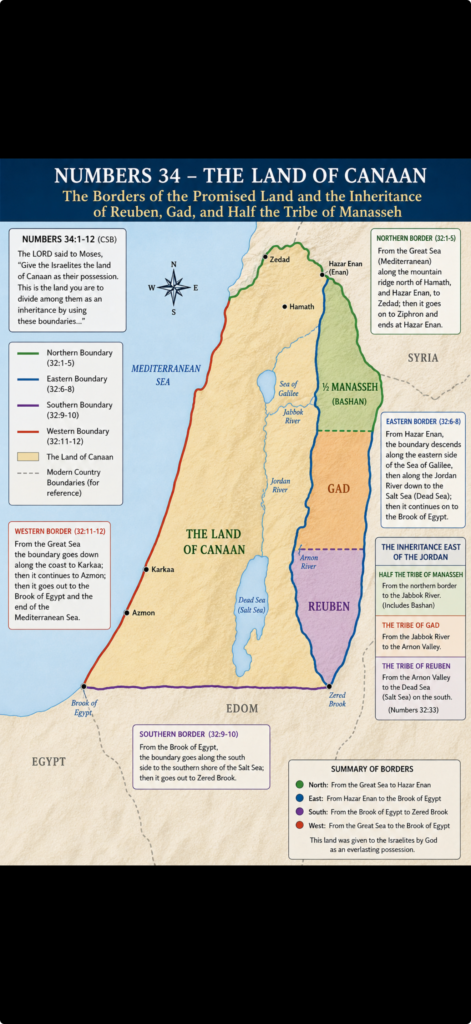
    Numbers 34 is a chapter about God giving Israel a defined inheritance in the Promised Land. It can seem like nothing more than a list of geographical boundaries, but there is a deeper biblical theme running through it. God keeps His promises, gives His people an inheritance, and appoints leaders to distribute it. God tells Moses exactly where Israel’s inheritance will begin and end. God isn’t simply telling Israel, “Go find some land.” He is saying, “This is the inheritance I am giving you.” This is important because Israel’s possession of the land was based on God’s promise, not their military ability. This chapter describes the land as the land that God was giving to Israel. This connects to a major biblical theme. God’s people receive what God provides. It is important to note that this land was not just given to Israel. Israel had to enter the land, fight battles, obey God, and occupy it, but the land itself was ultimately a gift from God. They ultimately had to be obedient to receive God’s promise. The same is true for us today. Putting our faith in what Jesus did for us on the cross is how we receive the inheritance God has promised us as believers today. Ephesians 2:8-9 says, “For you are saved by grace through faith, and this is not from yourselves; it is God’s gift — not from works, so that no one can boast.”

    Moses could bring Israel to the edge of the Promised Land, but Joshua would lead them into it. The Old Testament repeatedly demonstrates that the law and the old covenant could point God’s people toward God’s promise, but Jesus ultimately accomplishes what the law could not. Joshua gave Israel a temporary earthly rest. Jesus gives His people the ultimate rest. Numbers 34 is also extremely specific about how God establishes boundaries, appoints leaders, and establishes a process for distributing the inheritance. This tells us something about God’s character. It tells us that He isn’t a God of confusion or disorder. His promises have purpose and His plans have boundaries. The land wasn’t randomly divided. Every tribe would receive an inheritance according to God’s direction. Canaan was a real, physical inheritance for Israel. But the Bible eventually points us toward a much greater inheritance. Israel’s inheritance could be threatened, lost, invaded, and eventually divided. The inheritance believers receive through Christ is eternal. Revelation ultimately shows God’s people dwelling with Him in the renewed creation. God’s purpose has always been to dwell with his people from Eden, to the Promised Land, to Christ, and to the New Creation. What we should be careful not to miss is how before Israel made it to the promised land they wondered through the wilderness and a whole generation died because of unbelief. What we should realize is that people may fail, generations may pass, circumstances may change, but God keeps His promises. When Jesus said “it is finished,” the God’s promise was fulfilled. Love y’all! Have a great day!